Provision EC2-backed Trino clusters, wire up catalogs, and run SQL — all from one box. A Trino-aware autoscaler and auto-suspend tear down idle capacity automatically, so you pay for queries — not idle clusters.
Sign in to the demo as demo / trinohub-demo — read-only, on sample data. Browse clusters, catalogs, the SQL editor, notebooks, Ask Trino and MCP, and run real SQL against tpch and tpcds. The cluster is suspended, so your first query spends a minute or two starting it.
A control loop — not a raw CPU policy — scales workers on queued queries and CPU, with cooldowns and min/max bounds. Idle clusters auto-suspend, and a query against a suspended cluster resumes it first.
Pick a cluster, catalog, and schema, then ask a question in everyday language — or start from a suggested prompt. Ask Trino drafts the SQL with a short explanation, and one click sends it to the SQL editor to run against the same cluster.
SELECT — writes and multi-statements are rejectedTrinoHub serves a Model Context Protocol endpoint at /mcp over streamable HTTP, so Claude Code and other MCP hosts can list clusters, browse metadata, and run queries — against the same clusters, catalogs, and permissions your analysts already use.
list_clusters browse_metadata
Queryrun_query get_query_result
Templateslist_query_templates run_query_template
Data productssearch_data_products get_data_product
SELECT — clients run SHOW, DESCRIBE, and EXPLAIN too, which is what makes schema discovery and plan inspection work. EXPLAIN ANALYZE stays refused — it executes what it explains — and EXPLAIN re-validates whatever follows, so a write cannot ride in behind the keyword. Ask Trino remains SELECT-only.truncated: true flag.outputSchema and return structured content — no text scraping/.well-known/oauth-protected-resource, and an unauthenticated /mcp call answers with a WWW-Authenticate challenge pointing at it. Protocol revisions are negotiated per client — not hardcoded.The in-app MCP page hands you the endpoint, transport, and auth header as copy-able fields — plus ready-made setup for Claude Code, JSON-config clients, and curl.
A single EC2 instance runs the UI, API, and AWS orchestration. From there, operators launch clusters and analysts run SQL — no Terraform, no Kubernetes.
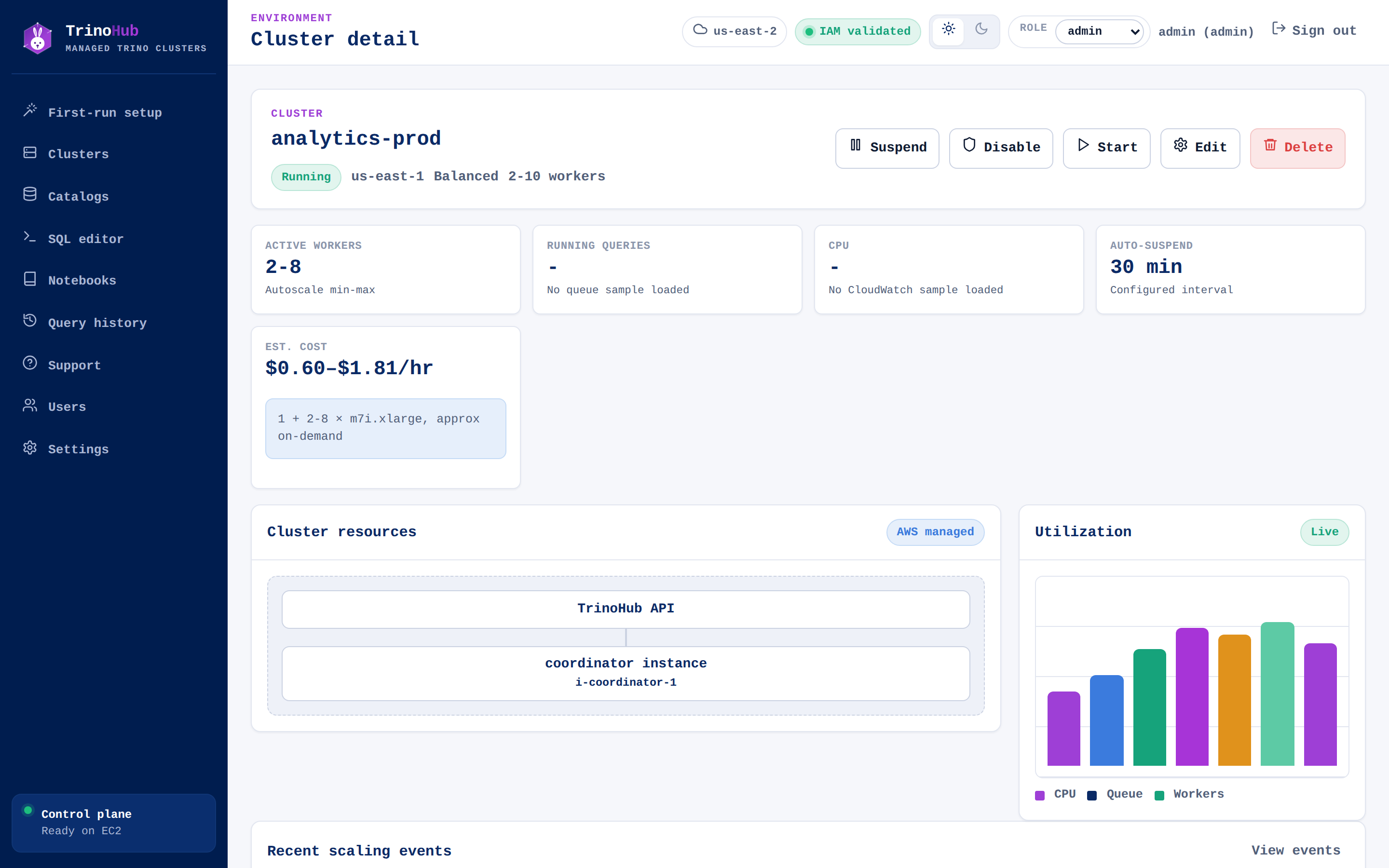
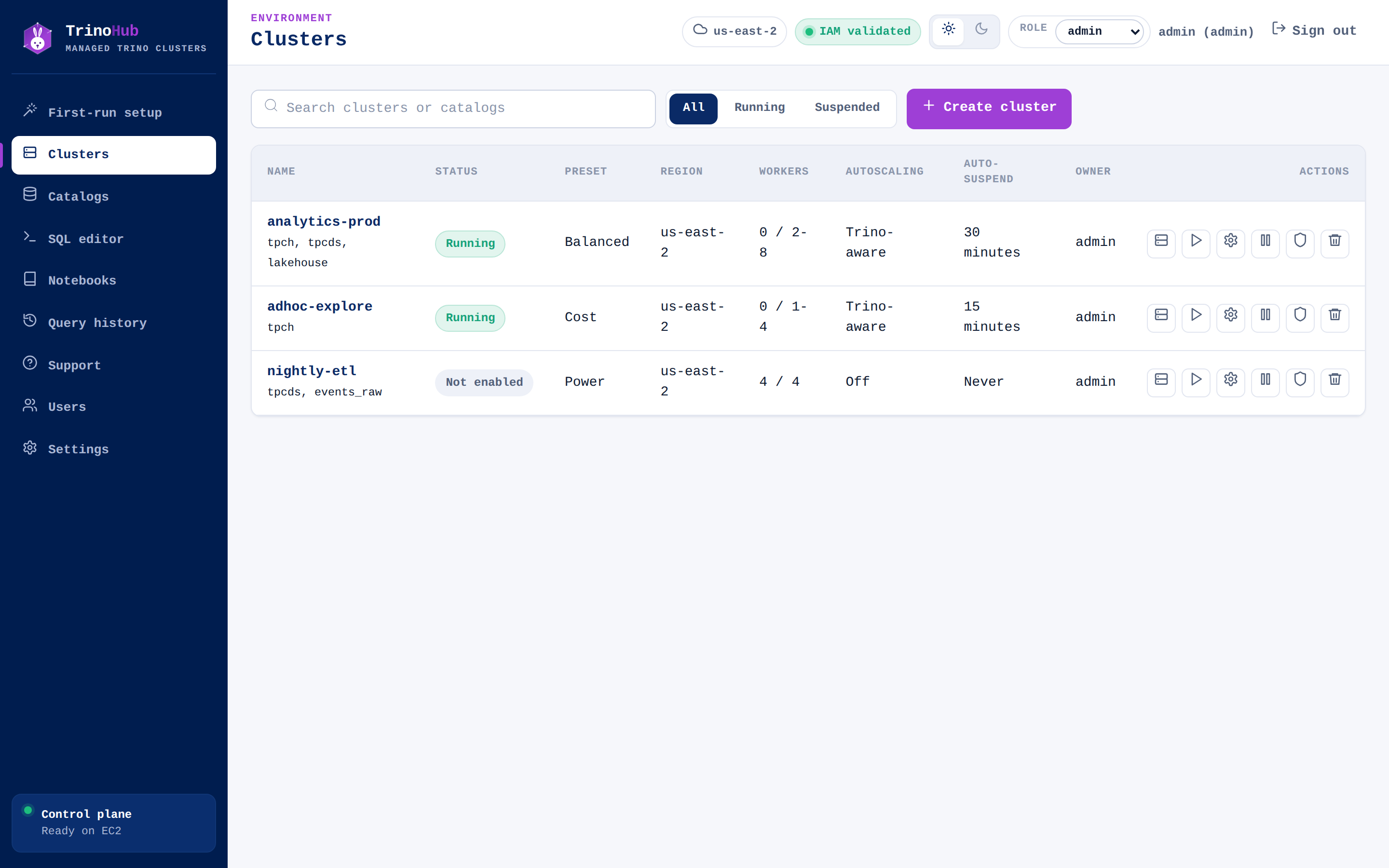
Create, start, suspend, disable, and delete EC2-backed clusters. Delete terminates every tracked AWS resource.
Scales workers on queued queries and CPU with cooldowns and bounds. Auto-suspend stops idle spend.
Built-in system, tpch, tpcds, plus S3 + AWS Glue Iceberg. Worker IAM grants access — no S3 keys stored.
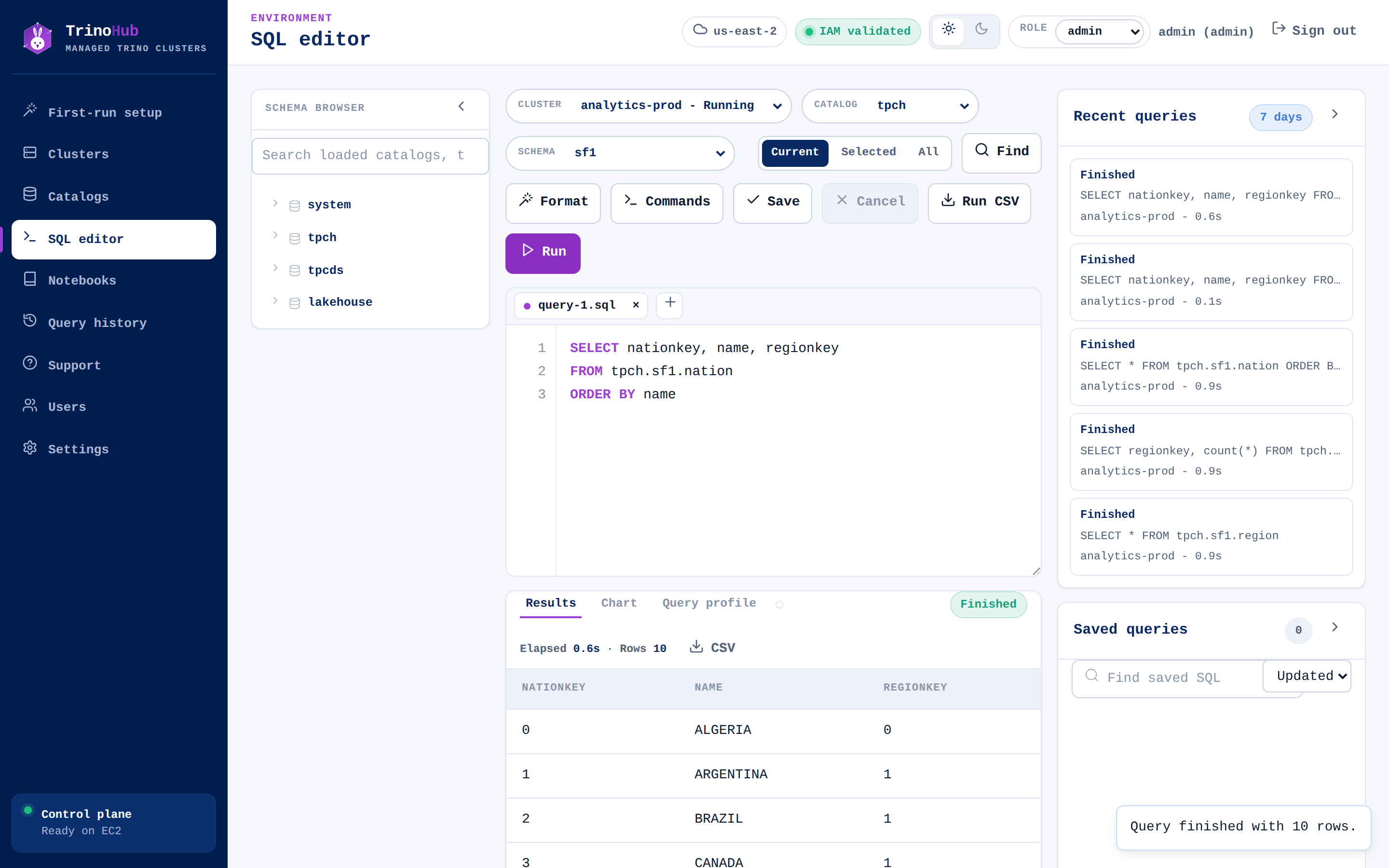
Schema browser, syntax highlighting, live status polling, tabular results, and streaming CSV export.
Ordered SQL cells with inline tables or charts, per-cell overrides, Run all, and autosave to your account.
Optional warm cache on local NVMe for S3-backed Hive, Iceberg, and Delta — repeated scans read from disk.
Documented bundles of tables and views — owner, tags, a description per asset — plus named SQL with typed {{placeholders}} that callers fill with values, never SQL. Agents find them by keyword instead of guessing from raw catalog metadata, and publishing one describes data without widening who can read it.
Every run with status, cluster, user, elapsed, and rows. Open a row for the full SQL, the catalog and schema context, the Trino query ID, and a per-stage execution breakdown.
Run one SQL statement on a cron or every-N-minutes schedule. A failed run retries once, and a job can run as a service account instead of you — with its own run history.
Every connector ships with TrinoHub — the picker, catalog forms, and credential handling all derive from a single registry. Add a catalog from the UI and it's queryable in seconds.
S3 + Glue catalogs authenticate with IAM roles — no stored secrets.
Query document stores and search indexes with plain SQL.
JDBC connectors configured from the UI — point at a host, add credentials, query.
Authenticate with a GCP service-account JSON key.
Zero-config catalogs for trying queries before wiring up real data.
TrinoHub installs into your own VPC. Query data flows between your worker nodes and your S3/Glue over your own network and IAM — nothing routes through a TrinoHub-hosted service.
One CloudFormation stack creates the IAM roles (instance-profile auth — no static keys), a security group, and an EC2 instance that installs and starts the app.
Prefer Terraform, or CloudFormation restricted in your account? The control plane is a plain FastAPI app behind nginx — install it on any Ubuntu 24.04 host you manage →
Pick a preset tier — Cost, Balanced, or Power — toggle autoscaling and auto-suspend, wire up catalogs, and hit create. Each cluster maps to a tagged set of AWS resources.
Analysts pick a cluster and catalog, write SQL with a live schema browser, watch query status, and download CSV — or organize it all into notebooks.